ApexRouter is building the operating layer for governed AI work.
ApexRouter is operated by APEX AI LABS LLP. The company is focused on making agentic AI useful inside real organizations: repeatable workflows, permission boundaries, auditability, model independence, and enterprise deployment readiness.
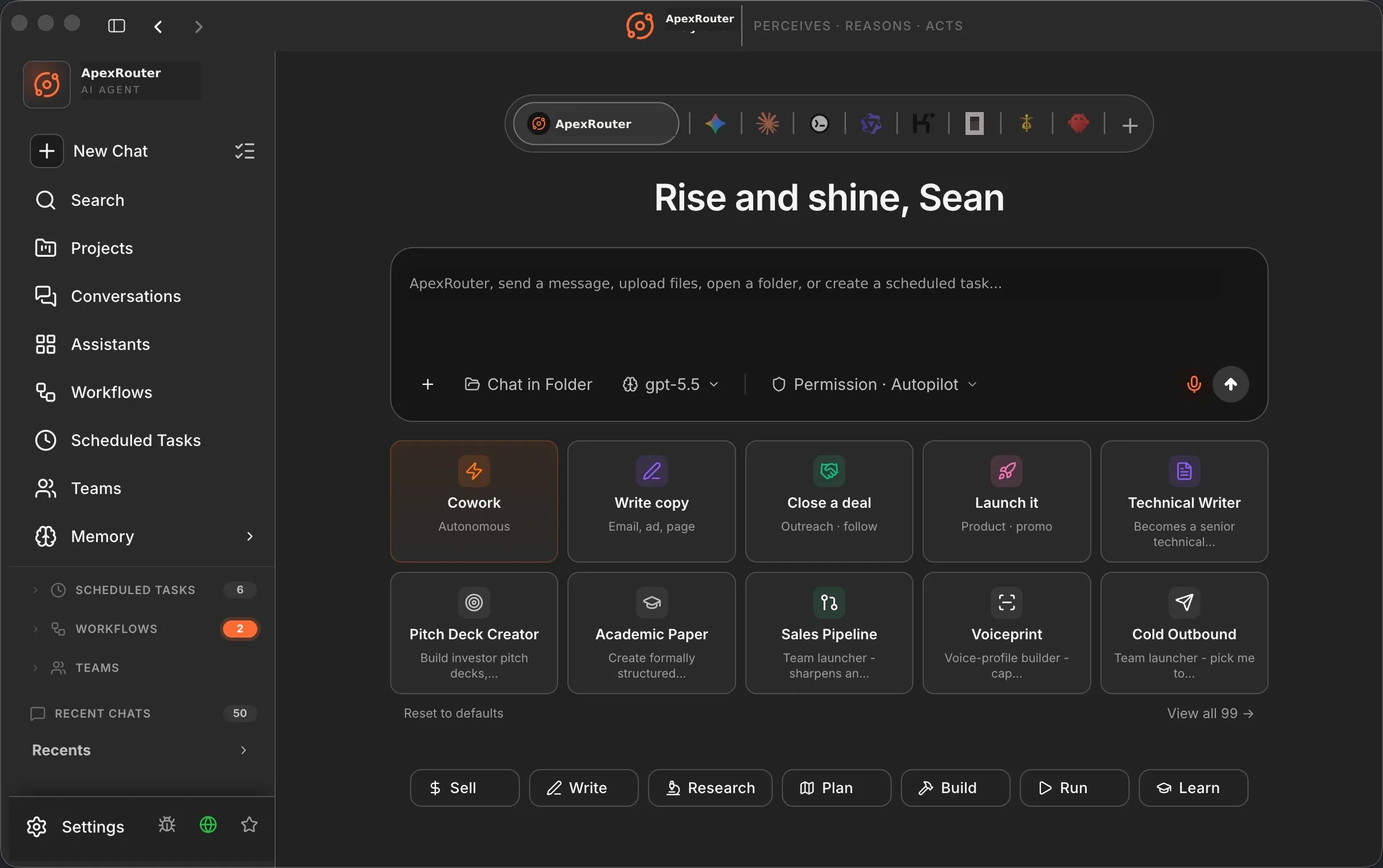
A control layer for the next operating model of AI work.
Teams are moving from occasional AI chat usage to repeatable agent workflows that touch repositories, documents, databases, customer systems, and internal operations. ApexRouter is positioned for that shift: a governed SaaS layer that turns agent execution into something teams can route, review, audit, and scale.
Why now
AI agents are becoming capable enough to operate across tools, but enterprises still need permission boundaries, traceability, human review, and repeatable workflow design before they trust them with real work.
Market wedge
ApexRouter starts where agent adoption is most painful: secure execution, model independence, workflow ownership, API embedding, and team-level operational visibility.
Business model
The platform is designed as subscription SaaS with workspace, API, workflow, governance, and enterprise onboarding expansion paths as customers move from pilots to production operations.
Built as infrastructure, not another AI wrapper.
The long-term thesis is that AI work becomes operational infrastructure. Teams will need a control plane that sits above models, agents, sandboxes, tools, and internal systems, then turns that work into something measurable and reviewable.
Operator first
Designed for repeated workflows, ownership, handoffs, approvals, and team-level visibility instead of isolated chat sessions.
Platform neutral
Works above the models, agents, tools, APIs, and execution providers customers already use or plan to adopt.
Public company profiles
GitHub: APEX AI LABS LLP
LinkedIn: APEX AI LABS LLP
Crunchbase: ApexRouter
F6S: APEX AI LABS LLP
A practical path from secure pilots to enterprise-scale AI operations.
Now
Private access, workspace governance, BYOK routing, sandboxed execution, scheduled tasks, trace logs, and dashboard-driven workflow operations.
Next
Deeper API events, richer approval workflows, workflow templates, expanded integrations, and stronger admin controls for pilots.
Enterprise
SSO planning, procurement support, policy templates, implementation onboarding, security reviews, and department rollout playbooks.
Scale
Multi-team adoption, usage analytics, integration depth, workflow reliability targets, and operating playbooks for larger deployments.