One security control plane for all your agent operations.
ApexRouter gives your team a repeatable way to connect agents, configure execution policies, attach governed memory, and run operations safely inside ephemeral E2B sandboxes.
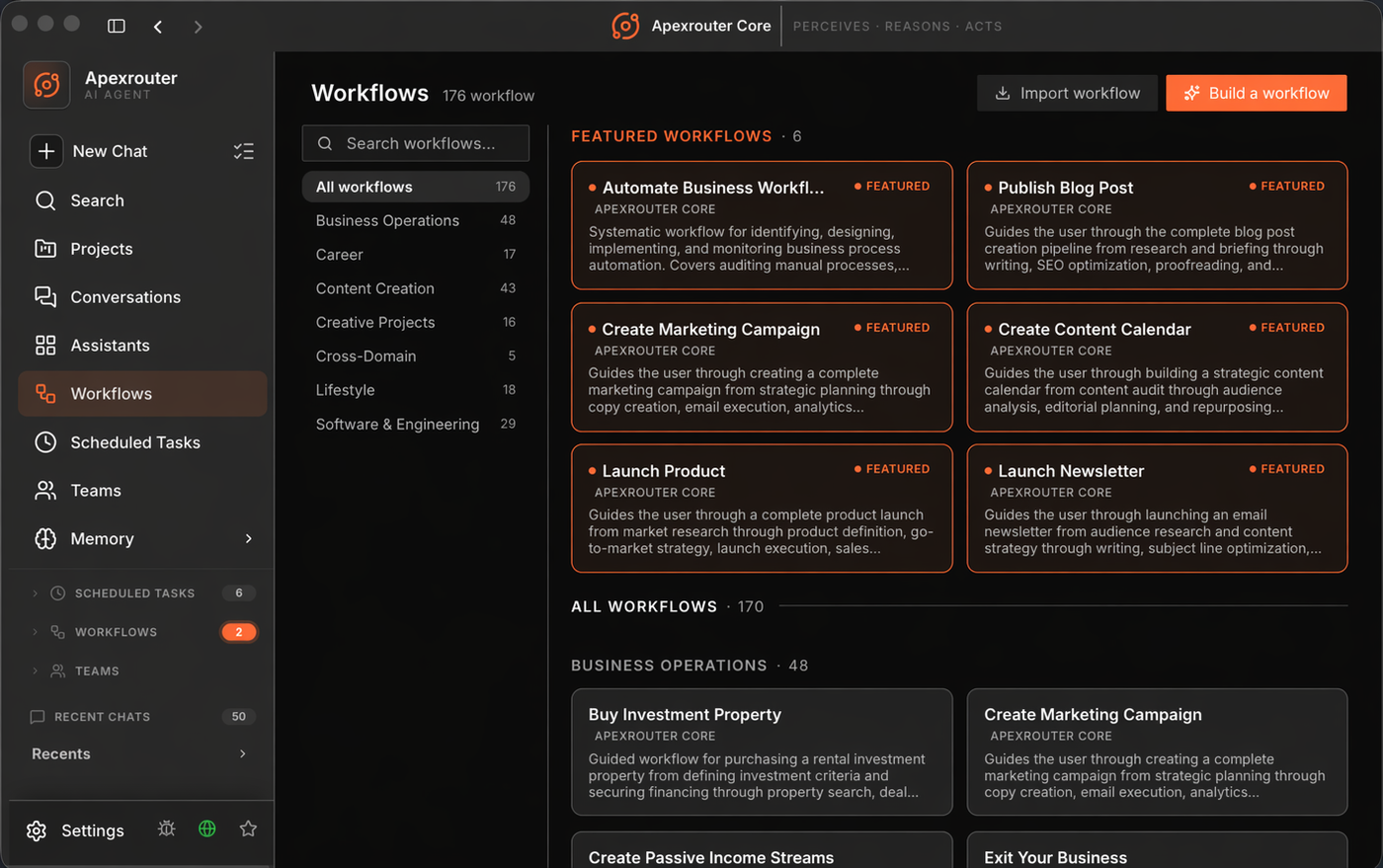
The ApexRouter loop.
ApexRouter mounts your security rules and memory, provisions isolated E2B sandboxes for execution, filters agent calls, and audits every change.
1. Connect
Bring your own LLM API keys and register your agents, workflows, and workspace boundaries.
2. Define
Configure filesystem permissions, network proxies, human approval thresholds, and operating rules.
3. Route
ApexRouter runs agents in isolated E2B sandboxes, auto-approving benign operations and gating critical actions.
4. Audit
Trace detailed logs of every command, edit, and tool request with full visibility and feedback loops.
Governance features built for real-world execution.
Workspaces segregate operations
Separate teams, credentials, secrets, memory, and permissions into secure workspace boundaries to ensure tenant isolation.
Bring Your Own Keys (BYOK)
Connect model endpoints directly using your own keys, with zero reseller markups or token markup overhead.
E2B Sandboxing
All coding, filesystem access, and command executions run inside ephemeral, isolated sandboxes instead of local machines.
Scheduled background runs
Set up recurring background agent runs with secure credential injection, trace logs, and automated notifications.
Multi-agent coordination
Orchestrate multiple agents cooperating on a target, using blackboard memory and review handoffs for complex tasks.
Compliance & Trace audit logs
Maintain detailed traces of every agent action, file modification, and network query for strict security compliance.
A practical sandboxed run.
Brief & context
Workflows start with goals, constraints, and workspace files. ApexRouter mounts this context securely into the E2B sandbox before execution begins.
Agent execution
The platform runs selected agents inside the isolated sandbox, monitoring all execution calls, shell inputs, and API tools in real time.
Permission filtering
Safe operations (like file reads) are auto-completed. Dangerous actions (like git push or external API calls) trigger interactive human reviews.
Audit & outcome
Finished work and trace logs are saved, and the sandbox container is destroyed, leaving no state or credential exposure on host systems.
Built for teams running AI in production workflows.
Operations
Daily summaries, status reports, recurring checks, process handoffs, internal knowledge retrieval, and structured follow-up.
Sales and growth
Account research, campaign planning, lead enrichment, proposal drafting, meeting preparation, and pipeline review workflows.
Product and support
Feedback triage, ticket summarization, release notes, help content, support routing, and product research workflows.