Enterprise-grade agent security and governance.
Coordinate agents, E2B sandboxes, workflows, permissions, and compliance from one control plane.
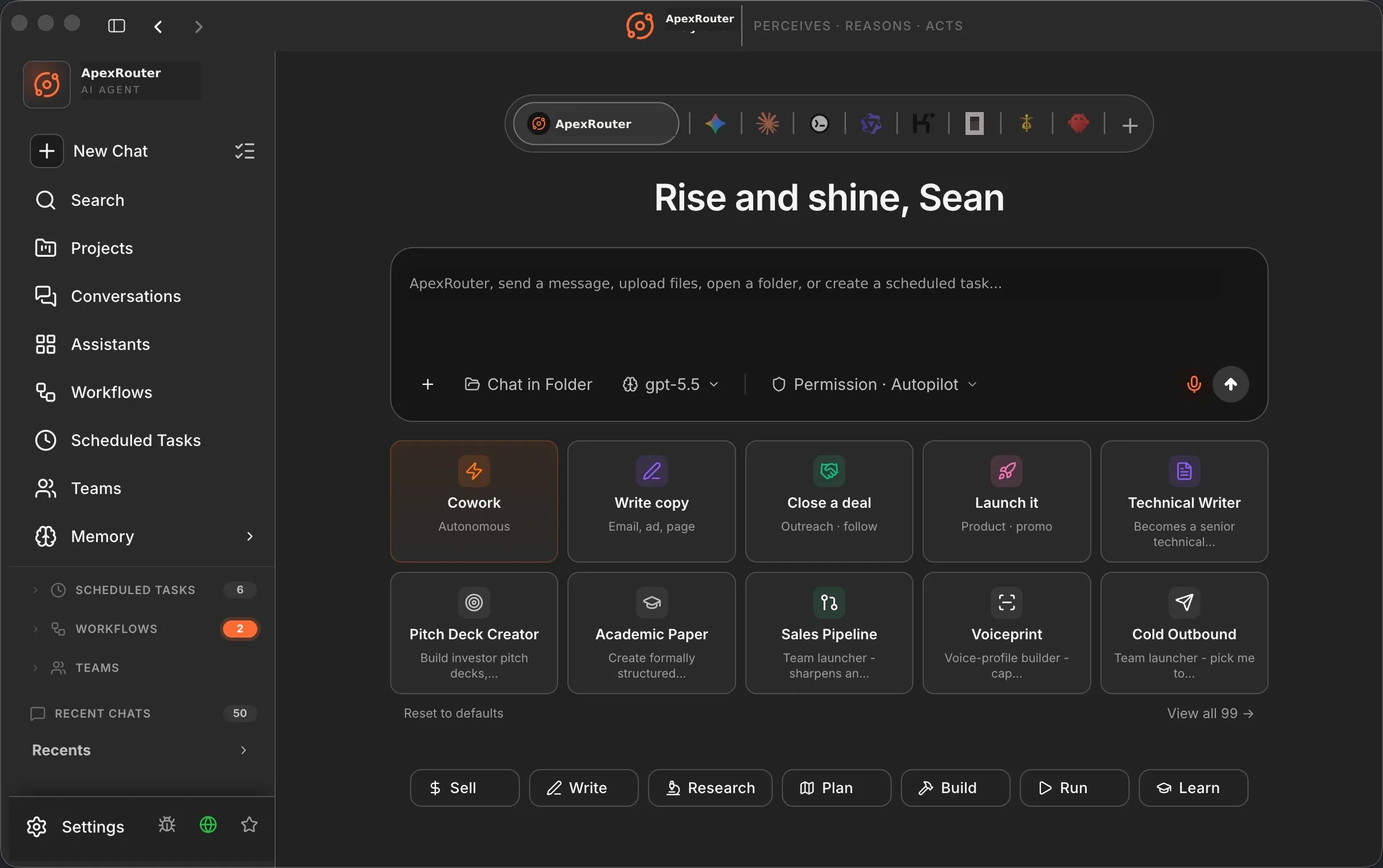
Built for teams that need reliable AI operations.
ApexRouter helps teams coordinate agents, tools, workflows, and access without relying on disconnected chats or one-off automations.
Agent Orchestration
Route tasks across connected agents (Aider, Claude Code) using your own LLM API keys.
E2B Sandbox Isolation
Run agent shell commands and code inside secure, isolated, ephemeral E2B sandbox containers.
Permission Policy Router
Configure filesystem, internet, and API access policies to automate safe tasks and gate risky operations.
Detailed Trace Logs
Audit every file write, command execution, and network request with comprehensive trace history.
Governed Workspace Memory
Keep context, documents, and decisions isolated to workspaces with strict tenant boundaries.
Compliance & SSO
Set budget limits, approval gates, and custom enterprise rules before scaling AI operations.
Built for reviewers who ask how agent work is controlled.
ApexRouter does not treat governance as a dashboard afterthought. The platform story is grounded in explicit execution boundaries, bring-your-own-key model routing, sandboxed workspaces, human approval points, audit logs, and clear ownership of every workflow run.
BYOK model routing
Customers connect their own model providers and keys so procurement, pricing, data handling, and provider choice stay under their control.
Sandbox-first execution
Agent work is designed to run in isolated execution environments with scoped tools, mounted context, runtime limits, and clean teardown after work completes.
Reviewable action path
High-impact actions can be paused for approval, denied, rerouted, or escalated while routine workflow steps continue under policy.
Trace-ready operations
Every workflow needs a readable chain of prompts, tool calls, file actions, approvals, errors, retries, and final outcomes for operators and auditors.
Tenant boundaries
Workspaces are the operating boundary for users, secrets, files, memory, workflows, integrations, and outcome history.
Responsible AI posture
The product narrative keeps human review, output validation, safety controls, and customer responsibility explicit instead of pretending agents are risk-free.
Where investor and enterprise reviewers should see immediate demand.
Developer automation
Run code review, repo maintenance, documentation, dependency analysis, migration planning, and release preparation with reviewable traces.
Customer operations
Summarize tickets, research accounts, prepare escalation briefs, draft follow-ups, and coordinate support handoffs through governed workflows.
Revenue operations
Research leads, enrich accounts, prepare proposals, monitor pipeline signals, and turn repeatable sales tasks into auditable workflows.
Internal knowledge
Connect policies, documents, historical decisions, meeting notes, and team preferences so agents can answer with workspace context.
Executive reporting
Schedule recurring summaries, risk checks, usage reports, project updates, and operational digests without manual status chasing.
Product operations
Turn feedback, research, release notes, QA findings, and roadmap inputs into structured workflows with ownership and review.
Ready for private access?
Join the waitlist to discuss your workflows, team size, and launch requirements.